

UNSERE NEUHEITEN

K-Gold Electroplating Solution – for Pen, Bath & Swab Plating (10 g) Professional cyanide-free gold electrolyte for selective and immersion plating The K-Gold electroplating solution is a premium, cyanide-free gold electrolyte designed for pen plating, swab (tampon) plating and bath electroplating. It is ideal for jewellery finishing, repair plating, precision components and controlled gold deposition on small parts. The solution deposits a high-purity gold layer (up to 24 K) with excellent adhesion and uniform thickness. It can be used pure or blended with coloured gold additives to achieve specific karat values and gold shades. 🔷 Key Features & Benefits High-purity gold electrolyte (≈ 10 g Au/L equivalent) Cyanide-free formulation for safer professional use Suitable for three plating methods: – Pen plating – Swab / tampon plating – Bath (immersion) plating Excellent adhesion on nickel, copper, silver and brass (proper pretreatment required) Soft, burnishable gold deposit with high visual quality ⚙️ Technical Parameters Gold concentration: approx. 10 g/L equivalent Deposit purity: 99.9–100 % gold Operating voltage: – Pen / swab plating: from 3.5 V – Bath plating: 3 V (current-controlled recommended) begin with 0,1 Ampere pro cm2 Temperature: 20–25 °C Recommended anode: Carbon or platinised titanium (bath) Hardness: approx. 170–180 HV Density: approx. 19.0 g/cm³ 🖊️ Pen Plating Application Ideal for localised plating, repairs and touch-ups. Clean, degrease and activate surface Load plating pen or swab with K-Gold solution Apply 2–3.5 V Move evenly across the surface to build the layer 🧽 Swab / Tampon Plating Application Best for controlled selective plating on larger areas. Soak swab with electrolyte Maintain gentle, even contact Keep voltage stable Repeat passes to achieve desired thickness 🧪 Bath Plating Application For uniform full-surface gold plating of small components. Thorough surface preparation Fill plating bath with K-Gold solution Use carbon or platinised titanium anode Apply low current density at 2–4 V Rinse and dry after plating ℹ️ Notes Air-sensitive – reseal container immediately after use Can be mixed with gold colour additives for karat matching Suitable for decorative and functional gold coatings
Content: 0.05 Liter (€1,900.00 / 1 Liter)

Nickel Anode / Plate Electrode (SW10083) Short Description The Nickel Anode / Plate Electrode with the soze of 100 x 60 x 0,6 mm is a high‑purity, flat nickel sacrificial anode designed for electroplating applications. It provides controlled nickel ion supply to the plating bath, ensuring stable processes and uniform nickel deposits — perfect for bath, pen and pad plating setups. Product Description This nickel plate electrode is made from high‑purity nickel (approx. 99.8 %) and serves as a sacrificial anode in electroplating. Its flat, broad design offers a large contact area in the electrolyte, promoting even current distribution, consistent metal release and reproducible plating results. Nickel anodes are commonly used to maintain a stable nickel ion concentration in the bath, reduce porosity, and act as a barrier layer before additional coatings like gold or chrome. Typical Applications Electroplating and nickel plating of metal parts Bath electroplating for decorative and protective nickel layers Barrier layers before further plating processes Workshop, laboratory and production electroplating Use in corrosion‑resistant contact applications Key Benefits High purity (~99.8 %): ensures clean nickel ion release Large surface area: promotes even current distribution in the bath Stable plating conditions: supports reproducible nickel deposits Improved adhesion and quality: suitable for both decorative and functional finishes Easy to use: flat shape fits standard plating tanks Usage Instructions Preparation: Clean, degrease and activate workpieces before plating. Setup: Place the nickel anode as the positive electrode (anode) in the electrolyte. Power connection: Connect the nickel anode to the positive terminal and the workpiece to the negative terminal (cathode). Plating: Operate within the recommended voltage and temperature ranges for your nickel electrolyte to achieve uniform layers. Maintenance: Periodic cleaning after extended use helps maintain performance. Conclusion The Nickel Anode / Plate Electrode is a robust and versatile accessory for nickel electroplating processes, offering a wide active surface, high purity and stable ion supply — ideal for bath, pen and pad plating across workshop, lab and production environments.

Nickel Anode / Plate Electrode (SW10082) Short Description The Nickel Anode / Plate Electrode with the soze of 170 x 30 mm is a high‑purity, flat nickel sacrificial anode designed for electroplating applications. It provides controlled nickel ion supply to the plating bath, ensuring stable processes and uniform nickel deposits — perfect for bath, pen and pad plating setups. Product Description This nickel plate electrode is made from high‑purity nickel (approx. 99.8 %) and serves as a sacrificial anode in electroplating. Its flat, broad design offers a large contact area in the electrolyte, promoting even current distribution, consistent metal release and reproducible plating results. Nickel anodes are commonly used to maintain a stable nickel ion concentration in the bath, reduce porosity, and act as a barrier layer before additional coatings like gold or chrome. Typical Applications Electroplating and nickel plating of metal parts Bath electroplating for decorative and protective nickel layers Barrier layers before further plating processes Workshop, laboratory and production electroplating Use in corrosion‑resistant contact applications Key Benefits High purity (~99.8 %): ensures clean nickel ion release Large surface area: promotes even current distribution in the bath Stable plating conditions: supports reproducible nickel deposits Improved adhesion and quality: suitable for both decorative and functional finishes Easy to use: flat shape fits standard plating tanks Usage Instructions Preparation: Clean, degrease and activate workpieces before plating. Setup: Place the nickel anode as the positive electrode (anode) in the electrolyte. Power connection: Connect the nickel anode to the positive terminal and the workpiece to the negative terminal (cathode). Plating: Operate within the recommended voltage and temperature ranges for your nickel electrolyte to achieve uniform layers. Maintenance: Periodic cleaning after extended use helps maintain performance. Conclusion The Nickel Anode / Plate Electrode is a robust and versatile accessory for nickel electroplating processes, offering a wide active surface, high purity and stable ion supply — ideal for bath, pen and pad plating across workshop, lab and production environments.
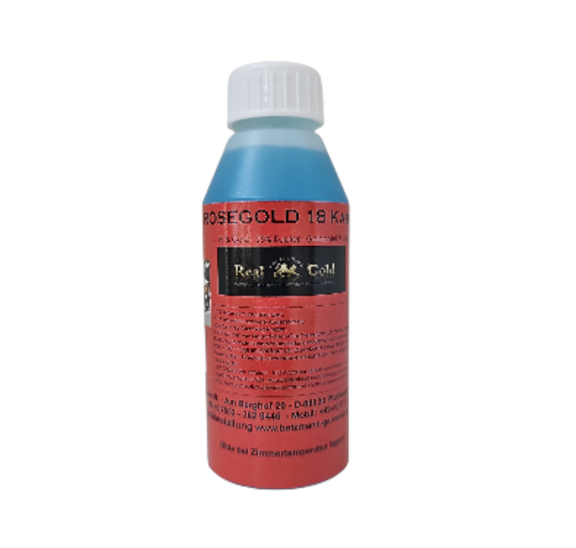
Rose Gold Electrolyte BMG‑118AM High-quality 18 K rose gold plating solution for decorative and functional coatings Short Description The Rose Gold Electrolyte BMG‑118AM is a ready-to-use electroplating solution for the deposition of 18 K rose gold layers on conductive metal surfaces. This cyanide-free plating bath produces a warm, reddish-golden tone characteristic of 18 K rose gold. The electrolyte can be used in tank, brush, and pen/peg plating and provides fast deposition and attractive appearance. Applications The rose gold electrolyte is used for: Decorative rose gold plating of jewelry, watch cases, and accessories Visual enhancement of metal surfaces with a warm rose-gold color Technical surfaces requiring durable rose gold finishes Multi-layer plating systems (e.g., base metal → rose gold) Applications needing a uniform, glossy 18 K rose gold coating Rose gold plating combines attractive color with good mechanical properties, suitable for decorative and functional applications. How Rose Gold Plating Works (Simple Explanation) Rose gold plating uses an electrolytic process in which a gold-copper alloy from the solution is deposited on the workpiece: Surface Preparation: Thoroughly clean and degrease the part. Activation: Optionally activate chemically for optimal adhesion. Rose Gold Plating: Apply direct current; metal ions are reduced from the electrolyte to form an 18 K rose gold layer. Finishing: Rinse and dry the plated part. The resulting layer is glossy, warm, and reddish-golden, typical for rose gold alloys. Benefits of Rose Gold Electrolyte BMG‑118AM Attractive 18 K rose gold color with warm reddish-golden tone Cyanide-free electrolyte with stable plating chemistry Fast deposition rate compared to many other plating solutions Suitable for tank, brush, and pen/peg plating Can plate directly on brass, nickel, silver, or gold substrates High-gloss, adherent layers with good corrosion and wear resistance Versatile for decorative and functional plating applications Technical Parameters PropertyValue / RangeElectrolyte typeRose gold plating solutionAlloy type18 K rose gold (gold-copper alloy)Gold contentapprox. 8 g/LCopper contentapprox. 3 g/LpHca. 7.2–8.0 (neutral)Density>1.07 g/mLVoltage1.4–1.8 VBath temperature55–60 °CAnode materialPlatinum-coated titaniumCurrent density0.1–0.5 A/dm²Deposition rateapprox. 45 mg/A·minPlating speedapprox. 0.1 µm/minMaximum layer thicknessup to 10 µmLayer hardness380–400 HV Practical Application Tips Preparation: Clean and degrease workpieces thoroughly. Optionally activate chemically for uniform adhesion. Plating: Maintain bath temperature at 55–60 °C and recommended voltage/current settings. Ensure even movement or agitation for uniform layer formation. Mask areas if selective plating is required. Post-treatment: Rinse with clean water and dry after plating. Light polishing can enhance shine if desired. Safety Information Rose gold electrolytes contain chemical components and must be handled carefully: Wear gloves, safety glasses, and protective clothing Avoid contact with skin and eyes Rinse immediately with water if contact occurs Work only in well-ventilated areas Do not ingest; keep out of reach of children Dispose of waste according to local chemical regulations Even though the electrolyte is cyanide-free, chemical reactions and fumes remain potential hazards. Conclusion The Rose Gold Electrolyte BMG‑118AM is a powerful and versatile 18 K rose gold plating solution. It provides fast, glossy, and warm-colored layers suitable for decorative jewelry, accessories, and technical applications. Easy to use in tank, brush, or pen/peg plating, it is ideal for hobbyists, workshops, and professional plating operations. Stable plating parameters ensure high-quality, consistent rose gold finishes.
Content: 0.05 Liter (€1,020.00 / 1 Liter)
Nickel Anode / Plate Electrode (SW10081) Short Description The Nickel Anode / Plate Electrode with the soze of 120 x 50 mm is a high‑purity, flat nickel sacrificial anode designed for electroplating applications. It provides controlled nickel ion supply to the plating bath, ensuring stable processes and uniform nickel deposits — perfect for bath, pen and pad plating setups. Product Description This nickel plate electrode is made from high‑purity nickel (approx. 99.8 %) and serves as a sacrificial anode in electroplating. Its flat, broad design offers a large contact area in the electrolyte, promoting even current distribution, consistent metal release and reproducible plating results. Nickel anodes are commonly used to maintain a stable nickel ion concentration in the bath, reduce porosity, and act as a barrier layer before additional coatings like gold or chrome. Typical Applications Electroplating and nickel plating of metal parts Bath electroplating for decorative and protective nickel layers Barrier layers before further plating processes Workshop, laboratory and production electroplating Use in corrosion‑resistant contact applications Key Benefits High purity (~99.8 %): ensures clean nickel ion release Large surface area: promotes even current distribution in the bath Stable plating conditions: supports reproducible nickel deposits Improved adhesion and quality: suitable for both decorative and functional finishes Easy to use: flat shape fits standard plating tanks Usage Instructions Preparation: Clean, degrease and activate workpieces before plating. Setup: Place the nickel anode as the positive electrode (anode) in the electrolyte. Power connection: Connect the nickel anode to the positive terminal and the workpiece to the negative terminal (cathode). Plating: Operate within the recommended voltage and temperature ranges for your nickel electrolyte to achieve uniform layers. Maintenance: Periodic cleaning after extended use helps maintain performance. Conclusion The Nickel Anode / Plate Electrode is a robust and versatile accessory for nickel electroplating processes, offering a wide active surface, high purity and stable ion supply — ideal for bath, pen and pad plating across workshop, lab and production environments.

Zinc Anode / Plate Electrode (SW10080) Short Description The Zinc Anode / Plate Electrode is a flat sacrificial anode made from high-purity zinc (Zn ≥ 99.8 %), designed for electroplating processes that require uniform, protective zinc coatings. It supplies zinc ions steadily into the electrolyte, promoting stable plating conditions and consistent deposit quality. Product Description This plate electrode is made from high-purity zinc and features a flat, broad geometry (approx. 100 × 80 mm) with a thickness of about 0.3 mm, making it suitable for plating larger surface areas evenly. As a sacrificial anode, zinc dissolves in a controlled manner, helping to maintain the metal content of the bath and provide stable plating conditions. The large active surface makes this electrode particularly suitable for bath electroplating with zinc electrolytes, ensuring uniform current distribution and improved coating quality. Typical Applications Electroplating of zinc for corrosion protection Bath plating for decorative or functional zinc finishes Plating of larger components requiring even coverage Workshop, laboratory, and educational electroplating processes Key Benefits High-purity zinc (≥ 99.8 %): supports clean, reproducible results Broad plate design: improves current distribution across surfaces Ideal for zinc electrolyte baths: enhances plating consistency Controlled electrolyte regeneration: maintains bath composition Simple to integrate: suitable for various electroplating setups Usage Instructions Preparation: Thoroughly clean and degrease the workpiece; activate if required. Placement: Position the zinc plate electrode as the anode (positive terminal) in the electrolyte, with the workpiece as the cathode. Plating: Set current and voltage according to the specific zinc electrolyte — typically low volt ranges are used. Maintenance: Clean the electrode periodically to remove oxide buildup and maintain performance. Conclusion The Zinc Anode / Plate Electrode is an efficient sacrificial anode designed for consistent and uniform zinc electroplating. Its large active surface and high material purity make it suitable for hobby, workshop, and professional electroplating applications alike.
Zinc Anode / Plate Electrode (SW10079) Short Description The Zinc Anode / Plate Electrode is a flat sacrificial anode made from high-purity zinc (Zn ≥ 99.8 %), designed for electroplating processes that require uniform, protective zinc coatings. It supplies zinc ions steadily into the electrolyte, promoting stable plating conditions and consistent deposit quality. Product Description This plate electrode is made from high-purity zinc and features a flat, broad geometry (approx. 100 × 80 mm) with a thickness of about 3 mm, making it suitable for plating larger surface areas evenly. As a sacrificial anode, zinc dissolves in a controlled manner, helping to maintain the metal content of the bath and provide stable plating conditions. The large active surface makes this electrode particularly suitable for bath electroplating with zinc electrolytes, ensuring uniform current distribution and improved coating quality. Typical Applications Electroplating of zinc for corrosion protection Bath plating for decorative or functional zinc finishes Plating of larger components requiring even coverage Workshop, laboratory, and educational electroplating processes Key Benefits High-purity zinc (≥ 99.8 %): supports clean, reproducible results Broad plate design: improves current distribution across surfaces Ideal for zinc electrolyte baths: enhances plating consistency Controlled electrolyte regeneration: maintains bath composition Simple to integrate: suitable for various electroplating setups Usage Instructions Preparation: Thoroughly clean and degrease the workpiece; activate if required. Placement: Position the zinc plate electrode as the anode (positive terminal) in the electrolyte, with the workpiece as the cathode. Plating: Set current and voltage according to the specific zinc electrolyte — typically low volt ranges are used. Maintenance: Clean the electrode periodically to remove oxide buildup and maintain performance. Conclusion The Zinc Anode / Plate Electrode is an efficient sacrificial anode designed for consistent and uniform zinc electroplating. Its large active surface and high material purity make it suitable for hobby, workshop, and professional electroplating applications alike.

Electroplating Pen Set for Pen / Pad Electroplating - Brush Plating The set consists of: 1x Hand electroplating handle made of high-quality brass - insulated - for various electrodes up to 6mm with quick release fastener Rear connection for measuring cable - front connection for electrodes up to 6mm 1x Lead PLUS1x Lead MINUS with crocodile clip1x stainless steel electrode 6 mm for degreasing, dechroming, activating, chrome plating1x graphite electrode 6 mm for silver plating, gold plating, palladium, platinum, black nickel, and much more.

40 A analog power unit - Betzmann Galvanik - Real Gold With this device you can easily coat all metallic surfaces and objects made of e.g. tin, zinc, brass, copper, nickel, silver and stainless steel and chrome-plated surfaces or chrome-plated plastic (conductive layer) with all metals available on the market. There is no size limit from 40 A! No matter if coins, screws or 20 meters of stainless steel pipes in one piece! - Real Gold (999-fine gold) - Rose gold, white gold, antique gold - Silver - Nickel - alkaline or acid copper - Chrome - Black Chrome - Rhodium - black rhodium - Palladium - Platinum - zinc, tin - Bronze So everything we have according to the price list MAAS SPS 8400 Switching Power Supply – Powerful Power Supply Unit for Radio ApplicationsThe SPS 8400 is a compact, powerful switching power supply with an output power of up to 40 amps. Designed for professional use, this power supply is ideal for supplying radio transceivers, radio equipment, and other communications technology applications that require a stable DC voltage. It impresses with its high reliability, versatile setting options, and sophisticated safety features. Thanks to the switchable fixed voltage of 13.8 volts or the variable range from 3 to 15 volts, the device offers flexible application options. Two analog measuring instruments allow precise monitoring of output voltage and current. The SPS 8400 is aimed at ambitious radio amateurs, service technicians, and operators of communication systems who depend on a stable and powerful power supply. Technical data Operating voltage: 230 volts AC / 50 Hz Output voltage: 3–15 volts DC adjustable or 13.8 volts DC fixed voltage Output current: 40 amps constant, 43 amps short-term Residual ripple & noise: < 50 mVLoad regulation: < 200 mV Line regulation: < 50 mV Displays & measuring instruments: Analog display for voltage and current, bi-color LED for operating status (green/red) DC connection sockets: Screwable pole terminals Cooling: Temperature-controlled fan Safety: Protection against overload, overheating, short circuit, reverse polarity, output voltage protection from 16.5 volts Extras: Dark gray metal housing with rubber feet, high efficiency > 78%, PFC > 0.95, high RFI stability Dimensions (WxHxD): 220 x 110 x 300 mm Weight: 3.5 kg Scope of delivery SPS 8400 power supply unit Operating instructions EAN code: 4044499025553

Power Unit - Rectifier 25 A galvanic unit - Betzmann Galvanik - Real Gold With this device you can easily coat all metallic surfaces and objects made of e.g. tin, zinc, brass, copper, nickel, silver and stainless steel and chrome-plated surfaces or chrome-plated plastic (conductive layer) with all metals available on the market. There is no size limit from 25 A! No matter if coins, screws or 20 meters of stainless steel pipes in one piece! - Real Gold (999-fine gold) - Rose gold, white gold, antique gold - Silver - Nickel - alkaline or acid copper - Chrome - Black Chrome - Rhodium - black rhodium - Palladium - Platinum - zinc, tin - Bronze So everything we have according to the price list Scope of delivery / technical details: Basic unit Power supply unit 2.7 - 15 Volt adjustable, depending on availability 25 Ampere analog display, power plug Switching power supply (switch mode) with two analog measuring instruments for output voltage and output current Technical data Operating voltage 200-240 voltsAC/50Hz Output voltage 3-15 volts DC adjustable or 13.8 volts DC fixed voltage via fixed voltage switch on the underside Output current 25 amps Short-term output current 28 ampsPower 375 watts Ripple &noise <50mV Load regulation <200mV Line regulation <50mV Displays & measuring instruments Analog meter for voltage and current, status bi-color LED red (fault) and green DC connection sockets Screwable pole terminals Cooling Fan Protection circuits Overload, overtemperature, short-circuit and reverse polarity protection, output voltage protection at 16.5 volts Extras Dark gray metal housing with rubber feet, high efficiency > 78% due to PFC (Dynamic Power Factor Correction) >0.95 maximizes the required current, high RFI stability Dimensions (WxHxD) 220x110x220 mm Weight 2.7 kg EAN code 4250158704367 Information for international customers: This series of HIGH POWER SWITCHING MODE DC REGULATED POWER SUPPLIES provide high current 25 amp output in a lightweight and compact size case. They are suitable for a wide range of uses, such as radio equipment, and are ideal for high power car stereo work. In addition to variable output from 3 to 15VDC, a fixed 13.8VDC can be selected. Overload, over temperature, and over voltage protection are standard.
UNSERE BESTSELLER

Brass Effect Mixer BMG-065M – Electroplating Additive for Brass-Like Finishes Short Description: The Brass Effect Mixer BMG-065M is a specialized electroplating additive designed to create brass-like color tones when mixed with a gold electrolyte. By adding this mixer to a standard gold solution, the deposited layer takes on the appearance of classic brass, making it ideal for decorative and functional surface finishes. What is the Brass Effect Mixer? The Brass Effect Mixer is a color-modifying additive that is mixed with a gold electrolyte (such as clear gold or gold flash). It alters the color of the deposited metal layer to resemble traditional brass alloys. Depending on the mixing ratio, the resulting shade can range from classic brass to lighter brass tones. What is it used for? Creating brass-like finishes during gold electroplating Mixing with standard gold electrolytes Fine adjustment of color tones for decorative applications Suitable for workshop, laboratory, and small-scale industrial use Application & Mixing Ratio Standard mixture (1:10): Produces a color similar to polished 70/30 brass alloy (approx. 14 K brass appearance). Lighter tone (1.5:10): Higher mixer ratios result in a lighter brass shade. Color tuning: The exact brass tone can be precisely adjusted by varying the mixing ratio. Recommended electrodes: Graphite electrode – reliable and cost-effective Platinum electrode – for very uniform and refined coatings Technical Information Deposition rate: approx. 2.6 µm/min (1:10 ratio, 3 V, graphite electrode) Operating temperature: approx. 20–25 °C Shelf life: up to 6 months under normal storage conditions Hazard information: Product is irritating – follow safety instructions Key Benefits Enables authentic brass-like finishes using a gold electrolyte Flexible color control through adjustable mixing ratios Compatible with commonly used gold plating solutions Ideal for decorative metal finishes and surface restoration Safety Notes Wear protective gloves and safety goggles during use Ensure adequate ventilation Avoid direct skin contact Follow all safety and handling instructions provided with the product documentation Conclusion The Brass Effect Mixer BMG-065M is a professional electroplating additive for producing brass-colored coatings from a gold electrolyte. With simple mixing and precise ratio control, it allows the creation of a wide range of brass tones – from classic polished brass to lighter variations – making it a versatile solution for decorative electroplating applications.
Content: 0.025 Liter (€1,428.00 / 1 Liter)

Green Gold Mixer BMG‑119 Additive for Creating Green Gold Shades in Electroplating Short Description The Green Gold Mixer BMG‑119 is a chemical additive used to adjust the color of gold plating solutions, allowing you to create green gold tones and antique gold effects. By mixing this additive with a clear gold electrolyte, a wide range of gold hues can be achieved – from soft pastel green to intense green gold or antique gold. Applications The Green Gold Mixer is used to: Create green gold shades in electroplated coatings Produce antique or special gold finishes Adjust color intensity by varying the additive-to-gold ratio Achieve decorative effects for jewelry, accessories, or metal objects Customize color tones to match design requirements How the Green Gold Mixer Works (Simple Explanation) The additive is mixed in a defined proportion with a clear gold electrolyte before electroplating: Prepare a clear gold plating solution. Add the Green Gold Mixer in the desired ratio (e.g., 1 part mixer to 10 parts gold solution). Stir the mixture thoroughly. Start electroplating – the deposited layer displays the intended green gold tone. Benefits of the Green Gold Mixer BMG‑119 Adjustable green gold tones, from light to intense Decorative and elegant finishes, ideal for jewelry or design objects Easy color control by changing the mixer ratio Compatible with clear gold electrolytes Flexible use in various electroplating processes Technical Parameters (Guideline Values) PropertyValue / RangeProduct typeAdditive for gold electrolyteApplicationColor adjustment for gold electroplatingMixing ratioe.g., 1:10 (Green Gold Mixer : clear gold solution)Color rangeLight green to antique/green goldCompatible withClear gold electrolytesElectrodePlatinum or graphiteVoltagefrom approx. 3 VStorageCool, dry, tightly sealed Note: Exact color depends on the mixing ratio and process parameters; testing is recommended to achieve the desired shade. Practical Application Instructions Preparation: Prepare the clear gold electrolyte. Measure the Green Gold Mixer according to the desired ratio (e.g., 1:10). Mixing: Combine mixer and clear gold solution thoroughly. Stir well before plating. Plating: Electroplate as usual; the resulting layer will display the green gold tone according to the mixture. Increase mixer ratio for deeper shades. Post-Treatment: Rinse plated parts with clean water. Dry and, if desired, lightly polish to enhance shine. Safety Instructions Wear protective gloves, goggles, and appropriate clothing Avoid contact with skin and eyes Rinse immediately with water if contact occurs Work in well-ventilated areas Do not ingest; keep out of reach of children Dispose according to local chemical waste regulations Conclusion The Green Gold Mixer BMG‑119 is a flexible additive for color control in gold electroplating. By combining it with a clear gold solution, you can create custom green gold and antique gold shades, making it an ideal tool for creative and decorative plating projects.
Content: 0.025 Liter (€1,904.00 / 1 Liter)

Nickel Strike / Bonding Nickel SW10031.2 Fast-acting bonding nickel electrolyte for improved adhesion of electroplated layers Short Description The Nickel Strike / Bonding Nickel SW10031.2 is an electroplating solution specially designed to deposit a thin but highly adhesive nickel layer on metal surfaces. This intermediate layer acts as a bonding agent between the base metal and subsequent electroplated layers (e.g., nickel, chrome, gold), ensuring improved adhesion, increased layer stability, and uniform coating quality, even on difficult-to-wet substrates. Applications The bonding nickel is used to: Enhance adhesion between the base metal and subsequent layers Prepare surfaces for electroplating systems (nickel, chrome, gold, etc.) Facilitate plating on challenging metals or surfaces Provide a uniform base for later coatings, especially on oxidized or passivated metals Prevent layer delamination or adhesion problems during plating How Bonding Nickel Works (Simple Explanation) To achieve strong adhesion, subsequent electroplated layers need a reliable interface with the substrate. The Nickel Strike deposits a very thin, active nickel layer before applying further coatings. This layer acts as a bonding intermediary, improving both chemical and metallic adhesion between the base metal and the overlying layers: Preparation: Clean, degrease, and optionally lightly activate the surface Bonding Nickel Plating: Apply a short electroplating cycle to form the thin adhesion layer Subsequent Coating: Immediately plate the next layers over the bonding nickel This method ensures significantly better adhesion, particularly on challenging substrates. Benefits of Nickel Strike / Bonding Nickel SW10031.2 Improves adhesion of subsequent electroplated layers Forms a thin, uniform bonding layer Reduces delamination and peeling Ideal for preparing oxidized or passive metals Suitable for tank plating, brush plating, and pen plating Effective on a wide range of base metals after proper pretreatment Technical Parameters PropertyValue / RangeElectrolyte typeBonding Nickel / Nickel Strike solutionOperating temperatureapprox. 20–30 °CVoltage (tank plating)approx. 1.5–4 VVoltage (brush/pen plating)approx. 3–7 VCurrent densityapprox. 1–3 A/dm²Anode materialNickel or graphiteLayer thicknessvery thin (adhesion layer, not full build-up)Base metalsStainless steel, copper, brass, steel, zinc (after pretreatment) Note: Values serve as practical guidelines and may vary depending on substrate and application. Practical Application Tips Preparation: Clean and degrease the workpiece thoroughly Optionally lightly activate to remove oxides Bonding Nickel Plating: Connect the workpiece as cathode Set voltage and current according to recommended parameters Plate only until the adhesion layer is formed (usually brief) Subsequent Layers: Plate additional layers immediately to avoid oxidation of the bonding nickel Safety Information Wear chemical-resistant gloves, safety glasses, and protective clothing Avoid contact with skin and eyes Rinse thoroughly with water if contact occurs Work in well-ventilated areas only Do not ingest; keep out of reach of children Conclusion The Nickel Strike / Bonding Nickel SW10031.2 is a reliable solution for improving adhesion in electroplating systems. By forming a thin, active nickel layer as an intermediate coating, subsequent layers become more uniform and durable. It is suitable for hobbyists, workshops, and professional electroplating facilities, especially when plating challenging metals or complex coating systems.
Content: 0.1 Liter (€95.00 / 1 Liter)

Beaker ring for holding the electrodes Beaker ring for holding the electrodes for our tank plating process. It comes in 2 sizes according to the volume of your Plating Beaker; 250ml - 7 cm diameter - for 2 Electrodes 500ml - 9 cm Diameter - for 4 Electrodes The Betzmann Galvanik tank plating process has been designed to provide the greatest degree of flexibity for our customers. It allows you to plate a wide range of differently sized objects with a variety finishes. Pictured is one of our 1 Litre electrode rings fitted into a 1 Litre Plating Beaker with the full quota of 6 copper electrodes for tank plating and the corresponding number of our Sleeves. Features Benefits Electrodes interchangeable between Brush and Beaker for the 250ml, 500ml and 1 Litre Electrode Ring Greater flexibility Made from non-corrosive materials Will maintain good conductivity at all times Features six threaded sockets to take six of our electrodes for tank plating Allows for greater flexibility as you can swap your electrodes around easily to accommodate differently sized and shaped objects Electrode Ring Properties Available electrode slots Slot diameter Ring OutsideDiameter 250ml Ring 2 6mm 69mm 500ml Ring 4 6mm 91mm 1 litre Ring 4 – 6 6mm 104mm 2 litre Ring 4 – 8 6mm 130mm

Copper Plate Electrode (SW10051M) Short Description The Copper Plate Electrode is a large‑area sacrificial anode made from high‑purity copper (≥ 99.9 %) designed for electroplating. It provides a consistent supply of copper ions to the electrolyte, promoting stable baths, uniform deposits and improved conductivity in copper plating applications. Product Description This plate is manufactured from pure copper, which dissolves evenly into the electrolyte to maintain a consistent metal ion concentration. The flat, broad surface makes it ideal for covering larger workpieces or for use in plating tanks where even current distribution is critical to achieving high‑quality copper coatings. Copper anodes like this plate are typically used in bath electroplating settings and can also serve as a foundation layer before other coatings such as nickel or chrome are applied. Typical Applications Electroplating of copper on metal substrates Bath plating for decorative or functional copper layers Undercoat / intermediate layer before nickel or chrome plating Workshop, lab and production electroplating Applications involving larger workpieces requiring extensive coverage Key Benefits High copper purity (≥ 99.9 %): clean ion release for consistent baths Broad plate design: promotes uniform current distribution Improved deposit quality: even, durable copper coatings Flexible use: suitable for a range of plating setups Easy integration: fits naturally into standard bath electroplating processes Usage Instructions Preparation: Thoroughly clean and degrease all workpieces prior to plating. Placement: Position the copper plate electrode as the anode (positive terminal) in the electrolyte. Connect: Attach the electrode to the positive output of your power supply and the workpiece to the negative (cathode). Plating: Adjust voltage and current according to the specific copper electrolyte used. Maintenance: Periodically clean off any buildup to maintain performance and longevity. Conclusion The Copper Plate Electrode is a reliable, versatile accessory for copper electroplating, offering consistent performance and uniform deposition thanks to its large active surface and high material purity — suitable for hobbyists, workshop use and professional electroplating environments alike.

Metal Polish Ultra – The Perfect Pre-Treatment for Premium Plating Quality For electroplating professionals and anyone who demands the highest surface quality: Metal Polish Ultra delivers industry-leading cleaning power and surface preparation for the best plating results. Ultimate Cleaning Power – Ideal Adhesion and Surface Prep This advanced formulation reliably removes: even very stubborn silicone and release agent residues embedded wax and polishing compounds fine contaminants and particulates unwanted metal films and oxidation products The built-in cleaner ensures deep-cleaned surfaces that form the ideal base for uniform, high-adhesion plating layers. Restore and Enhance Surface Brilliance Whether for restoration, repair, or high-end surface finishing, this premium polish combined with a fine microfiber cloth delivers: brilliant shine on chrome surfaces smooth, reflective results on conductive plastics effective removal of accidental coatings (e.g., gold) Challenging substrates are treated gently while still achieving a radiant finish. Key Benefits at a Glance Perfect pre-treatment for bath, brush, and swab plating Removes stubborn residues and embedded soils Improves adhesion and coating quality Suitable for metals, chrome, and conductive plastics Easy and controlled application Designed for workshop, professional labs, and industrial use Result: Technically pristine surfaces, enhanced coating performance, and an exceptional finish every time.
Content: 0.1 Liter (€128.00 / 1 Liter)

PP Copper Electrolyte BMG‑130.1 High-Gloss Copper Plating Solution for Electroplating Applications Short Description The PP Copper Electrolyte BMG‑130.1 is a high-performance electroplating solution for depositing bright, uniform copper layers. It produces thick, glossy coatings suitable for decorative surfaces, functional layers, or as a foundation for further electroplating processes such as nickel or gold. Applications The PP Copper Electrolyte is versatile and can be used for: Electrolytic copper plating of metallic surfaces Protective layers on iron and steel for corrosion resistance Intermediate layer or primer for nickel, gold, or other metals Coating conductive paint on plastics Decorative copper-red finishes Solderable layers for PCBs and electronic boards Its balanced composition makes it suitable for both hobbyist and professional applications in workshops, labs, or industrial environments. How Copper Electroplating Works (Simple Explanation) Electroplating uses direct current (DC) to reduce copper ions from the electrolyte onto the surface: Prepare the workpiece: Clean and degrease. Plating: Connect the workpiece as the cathode; use a graphite or copper anode. Deposition: Copper forms a thick, glossy layer. Post-treatment: Rinse with water and dry – the surface exhibits the characteristic bright copper-red shine. Benefits of PP Copper Electrolyte BMG‑130.1 Bright, uniform, glossy copper layers Thicker deposits than many standard copper solutions Excellent adhesion on conductive substrates Ideal as a base layer for nickel, gold, or other metals Easy to use with graphite or copper anodes Versatile application on plastics with conductive paint Technical Parameters (Guideline Values) PropertyValue / RangeProduct typePP Copper ElectrolyteElectrolyte typeBright copper plating solutionVoltageapprox. 3 V and aboveTemperature14–25 °CCopper content> 60 g/LDeposition rateapprox. 2 µm/min at 3.5 VLayer hardnessapprox. 380–385 HVLayer density8.8 g/cm³Anode materialGraphite or copperApplicationBath, pen, or tampon electroplating Note: Values are practical guidelines; results may vary depending on equipment, voltage, and temperature. Practical Application Instructions Preparation: Clean and degrease surfaces. For non-conductive parts, apply a conductive paint first. Plating: Operate the electrolyte within recommended voltage and temperature ranges. Use graphite or copper anodes for uniform layers. Post-Treatment: Rinse plated parts with water and dry. Light polishing can further enhance gloss if desired. Safety Instructions Wear protective gloves, goggles, and appropriate clothing Avoid contact with skin and eyes Rinse immediately with water if contact occurs Work in well-ventilated areas Do not ingest; keep out of reach of children Dispose according to local chemical waste regulations Conclusion The PP Copper Electrolyte BMG‑130.1 is a high-performance and versatile solution for producing bright, uniform copper layers. Whether for decorative finishes, corrosion protection, or as a foundation for further electroplating, it provides excellent layer quality, easy handling, and professional results for hobbyists, workshops, and industrial applications.
Content: 0.1 Liter (€90.00 / 1 Liter)
Electroplating Pen Set for Pen / Pad Electroplating - Brush Plating The set consists of: 1x Hand electroplating handle made of high-quality brass - insulated - for various electrodes up to 6mm with quick release fastener Rear connection for measuring cable - front connection for electrodes up to 6mm 1x Lead PLUS1x Lead MINUS with crocodile clip1x stainless steel electrode 6 mm for degreasing, dechroming, activating, chrome plating1x graphite electrode 6 mm for silver plating, gold plating, palladium, platinum, black nickel, and much more.

Schwefelsäure (10%, reinst)Andere Namen: Vitriolöl, Dihydrogensulfat, MonothionsäureGehalt: 10%, reinstCAS-Nummer: 7664-93-9EG-Nummer: 231-639-5EG-Index-Nummer: 016-020-00-8UFI: 3J60-N07J-5004-3VW2Lagerklasse: 8BUN-Nummer: 2796 Kategorie 0 - Chemikalien die nicht als Gefahrstoff klassifiziert sind, sowie Gefahrstoffe, für die laut Gesetz keine formale Verkaufseinschränkung besteht (Gefährlichkeitsmerkmale GHS02 (Flamme, jedoch nicht extrem entzündlich), GHS05 (Ätzwirkung), GHS07 (Ausrufezeichen) oder GHS09 (Umwelt). Abgabe an Jedermann!GHS-Kennzeichnungselemente: Signalwort: AchtungGefahrenhinweise:H290 Kann gegenüber Metallen korrosiv sein.H315 Verursacht Hautreizungen.H319 Verursacht schwere Augenreizung.Sicherheitshinweise:P102 Darf nicht in die Hände von Kindern gelangen.P280 Schutzhandschuhe / Augenschutz / Gesichtsschutz tragen.P305+P351+P338 BEI KONTAKT MIT DEN AUGEN: Einige Minuten lang behutsam mit Wasser spülen. Eventuell vorhandene Kontaktlinsen nach Möglichkeit entfernen. Weiter spülen.P332+P313 Bei Hautreizung: Ärztlichen Rat einholen/ärztliche Hilfe hinzuziehen.P362+P364 Kontaminierte Kleidung ausziehen und vor erneutem Tragen waschen.P337+P313 Bei anhaltender Augenreizung: Ärztlichen Rat einholen/ärztliche Hilfe hinzuziehen.P406 In korrosionsbeständigem Behälter / Behälter mit korrosionsbeständiger Innenauskleidung aufbewahren.

Zinc Electrolyte Brightener SW10073 Additive for Smooth, Shiny, and Uniform Zinc Coatings Short Description The Zinc Electrolyte Brightener SW10073 is a specially formulated additive that enhances the surface quality of electroplated zinc coatings. It produces smoother, more uniform, and shinier zinc layers, reduces micro-porosity, and improves corrosion resistance. Suitable for tank plating and brush/pen plating, the brightener is ideal for hobbyists, workshops, and professional applications. Applications The brightener is used to: Increase gloss and uniformity of zinc coatings Reduce micro-pores and uneven surfaces Fine-tune the appearance of zinc layers for decorative or functional purposes Enhance corrosion resistance Ensure uniform coverage on complex geometries Typical applications include repair work, hobby projects, automotive parts, fittings, technical components, and decorative elements. How it Works (Simple Explanation) The brightener influences the zinc ion deposition in the electrolyte, resulting in: Smoother, more uniform layers Fewer “crystal edges” or irregularities Brighter, higher-quality surface appearance The result is a shiny, fine, and uniform zinc coating without additional post-treatment. Advantages Increases the gloss of zinc layers Finer, more uniform structure Reduces micro-porosity Improves corrosion resistance Works in tank plating and brush/pen plating Suitable for hobby, workshop, and professional use Technical Information The brightener is added directly to a zinc plating bath and works only in combination with the corresponding zinc electrolyte: ParameterRecommended RangeConcentrationAdded according to manufacturer instructionsZinc Bath pHAcidic, depending on base electrolyteOperating Temperature15–60 °CVoltage (Tank Plating)0.5–3.5 V (approx. 2 V recommended)Voltage (Brush/Pen Plating)3–7 V (approx. 5 V recommended)Current Density0.25–2 A/dm² (up to 5 A/dm² possible)Anode MaterialZinc or graphite Note: The brightener is an additive, not a standalone plating solution. Practical Application Tips Dosage: Add to the zinc bath according to manufacturer recommendations. Bath Maintenance: Regularly check pH, temperature, and zinc concentration. Polishing: After plating, the surface can be polished for a brighter finish. Bath Agitation: Stirring or air bubbles can improve gloss uniformity. Safety Information Wear chemical-resistant gloves, eye protection, and protective clothing Avoid contact with skin and eyes Rinse thoroughly with water if contact occurs Use only in well-ventilated areas Do not ingest; keep out of reach of children Scope of Delivery Zinc Electrolyte Brightener SW10073 Quantity according to selection Conclusion The SW10073 Zinc Electrolyte Brightener improves zinc coatings, making them smoother, shinier, and more corrosion-resistant. Ideal for hobbyists, workshops, and professional galvanizing, it ensures perfect, high-quality zinc surfaces every time.
Content: 0.05 Liter (€396.00 / 1 Liter)
GOLDRICHTIG

Sie wollen selber galvanisieren - selber vergolden, selber versilbern, verzinken, selber verchromen oder mit anderen Metallen beschichten?
Dann sind Sie bei uns richtig!
Wir sind Ihr Ansprechpartner in allen Bereichen der Oberflächenveredelung und Metallbeschichtung
Wir verkaufen in unserem Galvanoshop sämtliches Galvanozubehör für die Stift-, Tampon Galvanik und Badgalvanik
Sie finden uns in der Nähe vom schönen Bodensee
Betzmann Galvanik
Am Berghof 20 - 88630 Pfullendorf / Germany
Tel.: +49 (0) 7552 - 382 9446
Fax: +49 -(0) 7552 - 382 9897
Kontakt bevorzugt per Whats App + Mobil: +49-(0) 177 - 694 20 10
E-Mail: [email protected]
Aufgrund hoher Nachfrage können derzeit wenig Telefonate angenommen werden!

Unsere Leistungen
Unser Haupttätigkeitsfeld liegt im Verkauf sämtlichen Zubehörs für die Stift- und Tampon Galvanik zum professionellen selber galvanisieren - selber vergolden, versilbern, vernickeln.: Sie finden bei uns im Shop alles zur Ausübung einer professionellen Galvanisierung: komplette Galvanikanlagen, Kleingalvanikanlagen, Galvanik Komplettset für das Verzinken, Versilbern, Verchromen oder Vergolden, die Sie natürlich sämtlich mit anderen Elektrolyten wie Platin, Palladium, Roségold o.ä. ergänzen und erweitern können. Sämtliche wichtigen Elektroden, Anodenhüllen, Anodenhalter, Kabel, Klemmen, Kupfer- und Silberleitlacke und natürlich auch alle bekannten Elektrolyte, die sowohl für die Stift-, Tampon- als auch für die Badgalvanik geeignet sind. Unsere Elektrolyte sind an Jedermann frei verkäuflich und dürfen somit von Jedem, egal ob fürs Hobby, Nebengewerblich oder Hauptgewerblich, erworben werden und sind für die Stift- Tampon und auch Badgalvanik geeignet!


Wir führen das beste und preislich interessanteste Goldelektrolyt am Markt mit 2, 4, 8 oder 12 Gramm Gold pro Liter, mit dem Sie die meisten Metalle wie Kupfer, Messing, Nickel, Edelstahl, Silber sogar direkt vergolden können. Aufgrund des zugesetzten Kobalt sprechen wir hier von einer Hartvergoldung! Diese ist antiallergen, lebensmittelecht und kann auch für Zahnprothesen und Schmuck der am Körper getragen wird, verwendet werden. Es ist sehr abriebfest und Sie können damit Schmuck, Fahrzeugteile, Instrumente und vieles mehr Hartvergolden.
Weiterhin führen wir Goldflash für optische Vergoldung, als Haftgrund oder als Zwischenschichten sehr gut geeignet, Weißgold, Roségold, Grün Gold, X-Gold, was sich direkt auf Chrom, Cromargan, Damast Stahl oder sogar auf Carbon Stahl sehr gut beschichten lässt.
Alle Elektrolyte werden von hochprofessionellen Laboren unter den aktuellen gesetzlichen Anforderungen hergestellt! Das Gold ist aus krisen- und konfliktfreier Herkunft!
Aber: Wir verkaufen nicht nur die gesamte Technik, hochmoderne Galvanikgeräte und komplette Galvaniksets für die mobile und gleichzeitig auch stationäre Galvanik, Elektrolyte und Zubehör, sondern wir schulen Sie bis zum Erfolg!
Wir verkaufen also nicht nur, sondern wir schulen und beraten Sie konstant und kostenlos!
Auch vermitteln wir Ihnen den Zugang zu Fachfirmen zur Oberflächenveredelung aller leitenden oder nicht leitenden Oberflächen. Sämtliche Metalle, verchromter Oberflächen, verchromter Kunststoffe. Auch die Neuverchromung von gebrauchten und beschädigten Teilen wie Oldtimer, Motorrad sowie auch die Neubeschichtung von Reflektoren und Schweinwerfern können wir anbieten.
SchulungsvideosWeiterhin die Beschichtungen und Veredelungen von
GOLDRICHTIG
Für ein Angebot benötigen wir immer Fotos und Maße und Anzahl der Teile!
Ihre Anfrage schicken Sie bitte per Mail an
[email protected]
Hinweis:
Aufgrund sehr hoher Nachfrage und vieler Großaufträge dauert die Bearbeitung derzeit ab Eingang der Teile bis zu 8 Monate!

Mit allen unseren Geräten können Sie Zuhause und auch unterwegs selber spielend einfach Gegenstände mit sämtlichen bekannten Metallen wie Gold, Silber, Chrom, Weißgold, Grün Gold, Palladium, Platin, Schwarzchrom, Roségold und vielem mehr beschichten.
Der Vorteil? Egal wie groß, egal wo, auch in eingebautem Zustand, im Freien, direkt am Fahrzeug, im Haus. Und alles ohne Tauchbäder, ohne giftige Stoffe und ohne spezielle Werkstätten oder Vorrichtungen. Direkt vor Ort. Leder, Perlen, Edelsteine, Kunststoff, Holz, Lack werden nicht angegriffen.
Beispiele: Schiffe und Yachten deren Messingteile ständig dem Salzwasser ausgesetzt sind, sind vergoldet davor geschützt. Badezimmeramaturen müssen nicht ausgebaut werden, somit kann das Bad während dem Vergolden weiterhin genutzt werden. Silberschmuck der anläuft kann rhodiniert werden. Unedler Edelstahlschmuck kann mit Weißgold oder Roségold beschichtet werden. Unschöne Uhrenbänder, Schmuck und sonstige antiken Gegenstände können neu beschichtet werden und erstrahlen im neuen Glanz. Musikinstrumente erhalten eine wunderbare Optik. Die Möglichkeiten sind fast grenzenlos. Das schonende und glanzerhaltende Entchromen von Felgen und sämtliche verchromte Teile ohne die darunter liegende Nickelschicht zu beschädigen ist ein weiterer großer Tätigkeitsbereich.
Wir führen das komplette Zubehör und sämtliche frei verkäufliche Verbrauchsmaterialien aus der Tampon- und Stiftgalvanik. Unsere Elektrolyte sind speziell für die Tampon Galvanik entwickelt worden, so dass für Sie ein ungefährliches Arbeiten möglich ist. Unser Goldelektrolyt verfügt im Gegensatz zu anderen Anbietern über 8 und sogar bis zu 12 Gramm Gold pro Liter ( 0,8 bzw. 1,2 Gramm pro 100 ml).
Wir weisen Sie beim Kauf unserer Geräte persönlich und umfassend in die Handhabung der Beschichtungssysteme ein, so dass Sie sicher und schnell alleine beschichten können. Und leisten auch im Anschluss kostenlose technische Unterstützung und sind immer für Tipps und Tricks persönlich erreichbar. Schulungen und Nachschulungen führen wir komplett kostenlos durch. Unterstützt werden Sie durch unser umfangreiches Handbuch, Leitfäden, Videos auf YouTube mit exakten Arbeitsanweisungen.
Sie bekommen unsere volle Unterstützung.
Optional bieten wir Ihnen auch die Möglichkeit unter der geschützten Firmenbezeichnung Real Gold und unserem Logo zu arbeiten. Hierbei erhalten Sie ein umfangreiches Businesspaket mit sämtlichen Dateien für Flyer, Visitenkarten, Briefkopf, Zertifikate, die von Ihnen benutzt und beliebig ergänzt und erweitert werden dürfen. Dabei sind sämtliche Nutzungsrechte an Texte, Videos und Fotos. Die Lizenzgebühr ist eine geringe Einmalgebühr. Weitere Gebühren und Umsatzbeteiligung gibt es nicht.
Metallteile vergolden: bestellen Sie uns das richtige Zubehör für die Oberflächenveredelung
Sie möchten Fahrzeugteile, Schmuck, Maschinenteile oder Alltagsgegenstände selbständig vergolden und Ihnen so zu einer ganz besonderen Optik verhelfen? Dann können Sie sich auf uns verlassen. Wir haben uns auf die Vergoldung verschiedenster Oberflächen spezialisiert und halten in unserem Online-Shop das komplette Equipment und Zubehör hierfür bereit. Als Experte für Oberflächenveredelung statten wir Sie mit hochwertigen Produkten aus, die dafür sorgen, dass Sie problemlos selber galvanisieren können. Vielleicht suchen Sie aber auch einen Fachmann, bei dem Sie diverse Metallteile vergolden lassen können. Auch dann können Sie sich auf uns verlassen. Gern vermitteln wir Ihnen die gewünschten Kontaktdaten.
Warum lohnt es sich, Schmuck und andere Metallteile zu vergolden?
Es gibt gleich mehrere Argumente, die für das Vergolden als Beschichtung sprechen. In erster Linie muss hier natürlich die optische Attraktivität genannt werden, die Gold hat. So hat das Edelmetall seit Jahrhunderten eine ganz besondere Anziehungskraft auf die Menschen. Doch das ist noch nicht alles: Gold ist korrosionsbeständig. Werden andere Metalle vergoldet, profitieren sie von der Korrosionsbeständigkeit. So kann diese durch das Vergolden auf die anderen Metalle übertragen werden.
Warum werden Metallteile vergoldet und nicht direkt aus Gold hergestellt?
Obwohl Gold so populär ist und auf breiter Ebene viel Anerkennung genießt. ist es als Grundwerkstoff für verschiedene Metallteile wenig geeignet. Das hat verschiedene Gründe. Zum einen hat es nur eine geringe Festigkeit, sodass es sich leicht deformieren lässt. Ihm fehlt also die nötige Stabilität und Langlebigkeit. Zum anderen ist Gold schlichtweg sehr teuer, sodass es für die meisten Unternehmen aus wirtschaftlicher Sicht unattraktiv ist, Gold als Grundmaterial zu verwenden. Das Vergolden bleibt damit das Mittel der Wahl.


Wir führen Ihnen - gerne auch am Wochenende - unsere Geräte hier in unserem Hause vor
Folgen Sie uns auf Social Media


Auszeichnungen
